Prosper Enfantin: Colonisation de l’Algérie

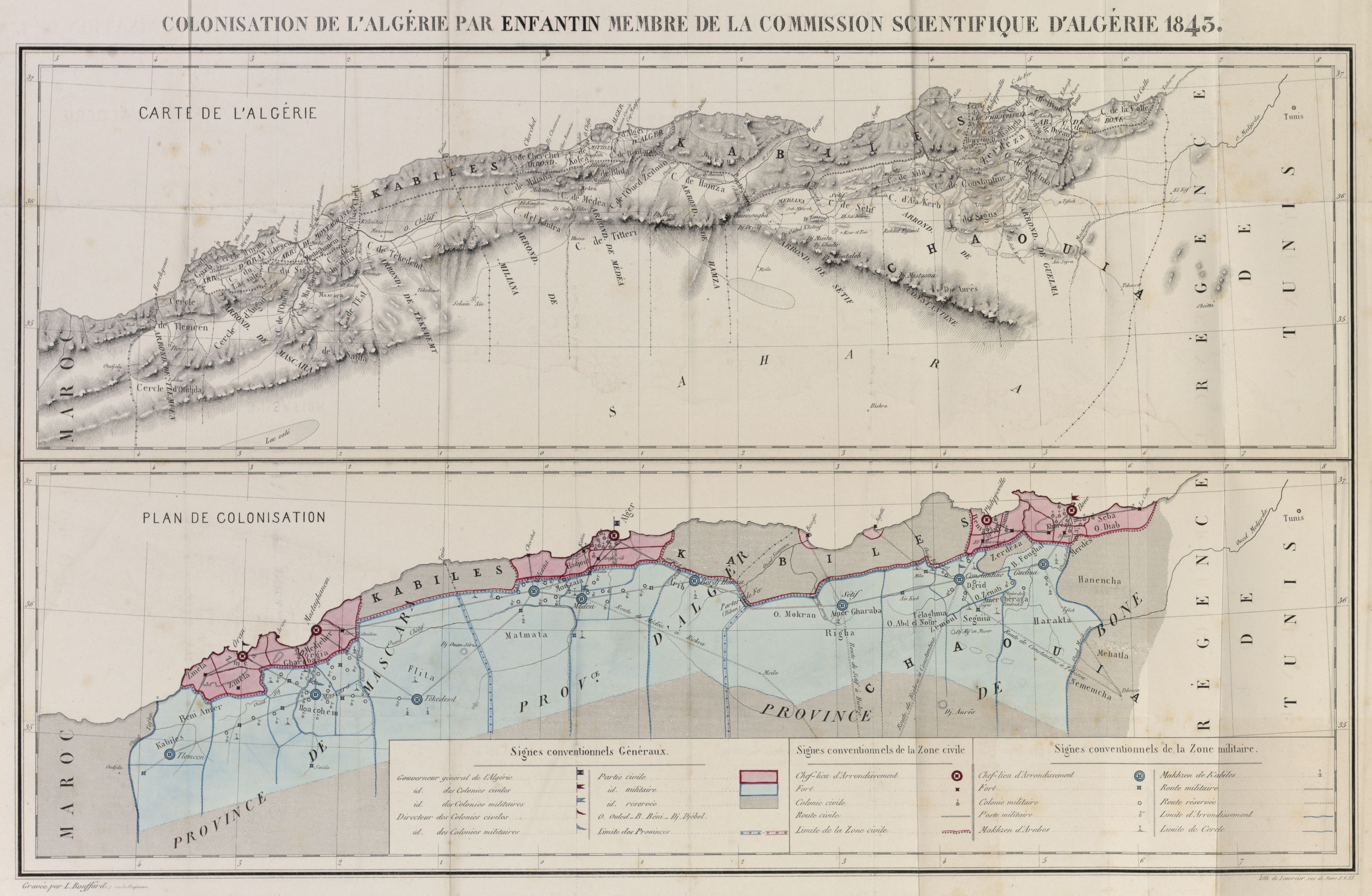
This week’s image from The Connectivity of Things is a colonialist map. It was published as a fold-out part of Prosper Enfantin’s 1843 book Colonisation de l’Algérie. In this treatise, the Saint-Simonian cult leader Enfantin was upfront about the strategic placement of settlements and settlers in Algeria. While the early socialist movement of Saint-Simonians movement had started with utopian dreams of a new networked unity of orient and occident in the 1830s, this map deliberately drew a reséau de soumission –– a network of colonial submission and police power.

Chapter 3 of the book is focused on theory and heuristics of writing network history in „An Archive of Networking.“ Yet, this map features prominently in chapter 4 of the book. It is called „Channels: The Politics of Networking around 1850,“ and it deals with the ambivalent history of network ideology and practice in early socialism. There’s not just a breathtaking colonial history to be told here –– which includes the Suez Canal –– but also one of early feminism, romanticism and social engineering. I’ll come back to the Saint-Simoniennes and Saint-Simoniens next week.

Prosper Enfantin, Colonisation de l’Algérie. Engraving by L. Bouffard, lithograph by Joseph Lemercier, 1843. 49.5 cm × 66.5 cm. Courtesy of Bibliothèque Nationale de France.

The Stele of Vultures

Chapter 2 of The Connectivity of Things: Network Cultures since 1832 is called „Six strata of network history: Genealogy of a cultural technique“. Actually, this one has been written almost exclusively from scratch for the English version of the book. It carves out two main themes of the book. Firstly, this chapter is about research on cultural techniques, and what this means for an Anglophone audience. And secondly, I am telling the longue durée story of nets and networks in a very condensed form.

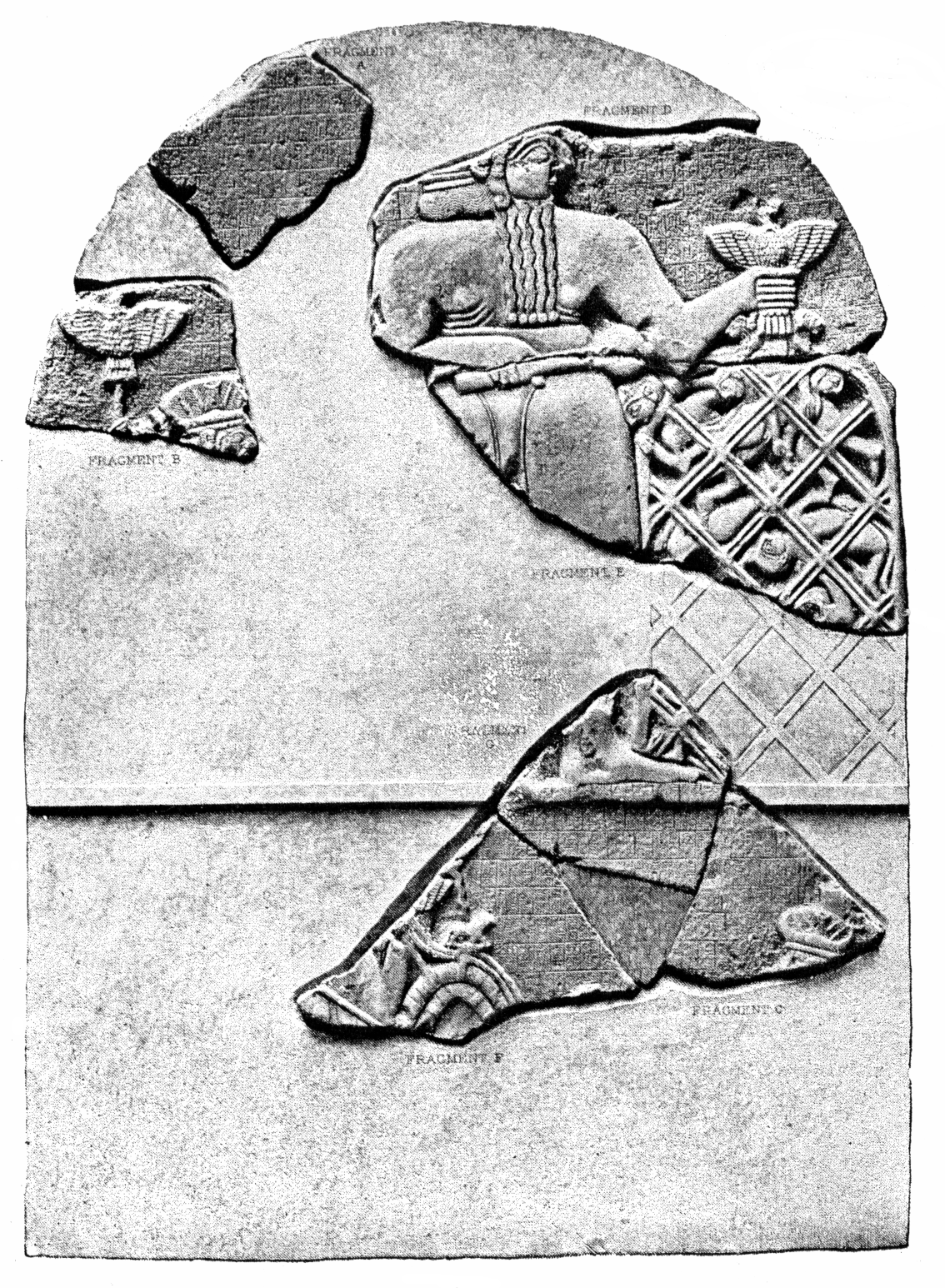
This week’s image resonates with that genealogy which uncovers six strata of network history: material culture, mythology and religion, reticular nets, infrastructural nets, social networks, and network science. (Connectionist artificial intelligence might develop into a seventh stratum, but this remains to be seen.) The so-called „Stele of Vultures“ resides in today’s Louvre. In the spatial logic of the Paris museum’s collection it represents the beginning of cultural history. In the Louvre you’ll not just find the fragments of a net of power that holds and punishes the enemies of the city-state of Lagash. The stele is surrounded by a multitude of smaller objects of Sumerian everyday culture. Nonetheless, it remains a stunning testimony of ancient civilization’s symbolization of the net as a network of binding, holding, and ruling power.

Eannatum catches the enemies of the city of Lagash with a net. Fragment of the Sumerian Stele of Vultures, circa 2440 BCE. Limestone. Reconstructed original size: 130 cm × 180 cm; depth: 11 cm. Louvre, Paris, inv. no. AO 50.


Paolo Veronese: L’industria

Since The Connectivity of Things: Network Cultures since 1832 is coming out on October 15 I might as well blog about some of the book’s visual elements. The book has eleven chapters, so this will be a weekly series of eleven images that convey and carry Connectivity’s narrative. These will be brief entries, since the images themselves are key protagonists of my network history. I do hope that they inspire deeper reading.

Let’s start with Paolo Veronese and his workshop who finished their allegory of „industry“ in 1577. This oil painting makes its appearance in chapter 1, which is called „Getting caught up“. It has already served as a frontispiece for the German original Die Verbundenheit der Dinge. From my point of view, it is the first heterogeneous network that represents and transcends the material net as web between nature and culture. Veronese’s network evokes a multitude of meanings, some of which I address in the first chapter. Up until today it is one of the most stunning artworks in the Palazzo Ducale of Venice.

Paolo Veronese, L’industria. Oil on canvas, 1575–1577. Palazzo Ducale, Sala del Collegio, Venice.

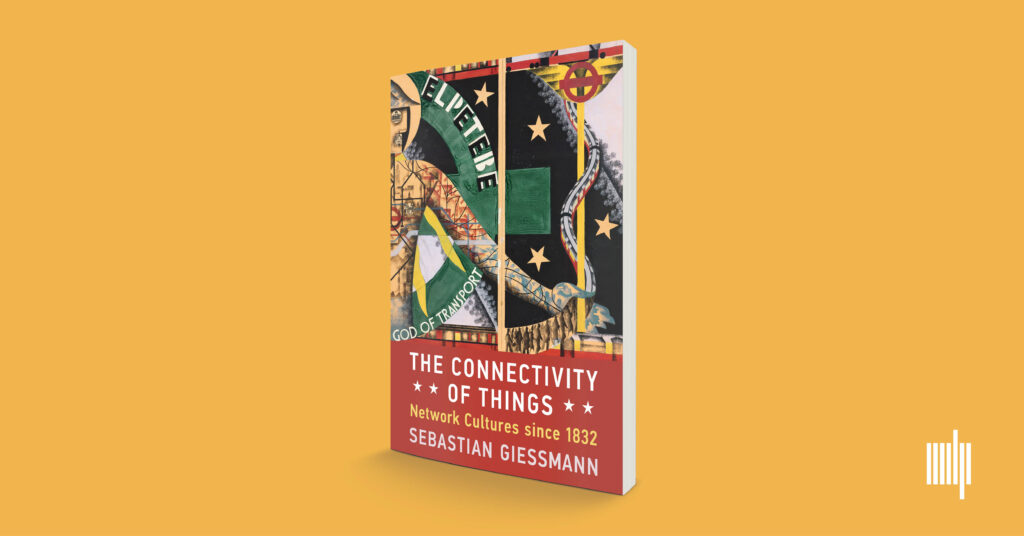
The Connectivity of Things: Network Cultures since 1832

Nets hold, connect, and catch. They ensnare, bind, and entangle. Our social networks owe their name to a conceivably strange and ambivalent object. But how did the net get into the network? And how can it reasonably represent the connectedness of people, things, institutions, signs, infrastructures, and even nature? The Connectivity of Things by Sebastian Giessmann, the first media history that addresses the overwhelming diversity of networks, attempts to answer all these questions and more.

Reconstructing the decisive moments in which networking turned into a veritable cultural technique, Giessmann takes readers below the street to the Parisian sewers and to the Suez Canal, into the telephone exchanges of Northeast America, and on to the London Underground. His brilliant history explains why social networks were discovered late, how the rapid rise of mathematical network theory was able to take place, how improbable the invention of the internet was, and even what diagrams and conspiracy theories have to do with it all. A primer on networking as a cultural technique, this translated German classic explains everything one ever could wish to know about networks.

A media history of the material and infrastructural features of networking practices, a German classic translated for the first time into English.

The MIT Press, Infrastructures Series
October 15, 2024
444 pp., 6 x 9 in, 82 b&w illus.
Open Access version: https://doi.org/10.7551/mitpress/12547.001.0001

„The Connectivity of Things: Network Cultures since 1832“ weiterlesen

Die erste App: kleine Geschichte der Kreditkarte

Die Kreditkarte ist ein Kind des 20. Jahrhunderts. Sie gehört zum Erbe der US-amerikanischen Konsumkultur und der „dreißig glorreichen Jahre“ des westlichen Kapitalismus nach dem Zweiten Weltkrieg. Aber trotz neuer Finanztechnologien im mobilen digitalen Bezahlen bleibt sie weltweit das führende Zahlungsmittel.

Alte Kreditkarten und neue Apps mischen sich dabei auf paradoxe Weise: Sechs Jahre nach dem Start von Apple Pay als smartphone-basiertem Bezahldienst bot Apple 2020 in Zusammenarbeit mit Goldman Sachs eine eigene physische Kreditkarte an. Nun mit einem Smartphone-Wallet gekoppelt, löste sie eine Neugestaltung der bestehenden Plastikkarten aus. Die schon länger obsolete, leichte Erhöhung der persönlichen Daten, die einst durch Papierabdruck die Nutzung von Kreditkarten per Formulardurchschlag erlaubt hatte, ist verschwunden. Das soziale Prestige der Kartennutzer:in äußert sich jetzt weniger darin, mit ihrem guten Namen zu bezahlen, sondern in den Werten der Walletdaten auf ihrem mobilen Bildschirm. Namen, Kreditkartennummer und weitere persönliche Daten sind in den letzten Jahren mehr und mehr auf die Rückseite der Karten gewandert. Nach der Covid-19-Pandemie ist zudem die persönliche Unterschrift auf Rechnungen deutlich seltener geworden.


Mit dem Wechsel im Kartendesign reagiert die Banken- und Kreditkartenindustrie auf die von Big Tech gesetzten Maßstäbe im digitalen Bezahlen. Aber kann sie mit den nicht-westlichen Innovationsdynamiken von Finanztechnologien noch Schritt halten? Chinesische Unternehmen wie Alibaba und Tencent haben die bank-basierte Kartenform des digitalen Bezahlens durch app-basierte Dienste übersprungen. Vergleichbares gilt für die Entwicklung des mobilen Bezahlens in afrikanischen Ländern. Warum aber halten sich Kreditkarten trotzdem hartnäckig als Bezahlmittel und Geschäftsmodell, das sogar neue Allianzen mit der Welt der Krypto-Assets eingehen kann?

„Die erste App: kleine Geschichte der Kreditkarte“ weiterlesen

What’s Digital About Digital Media?

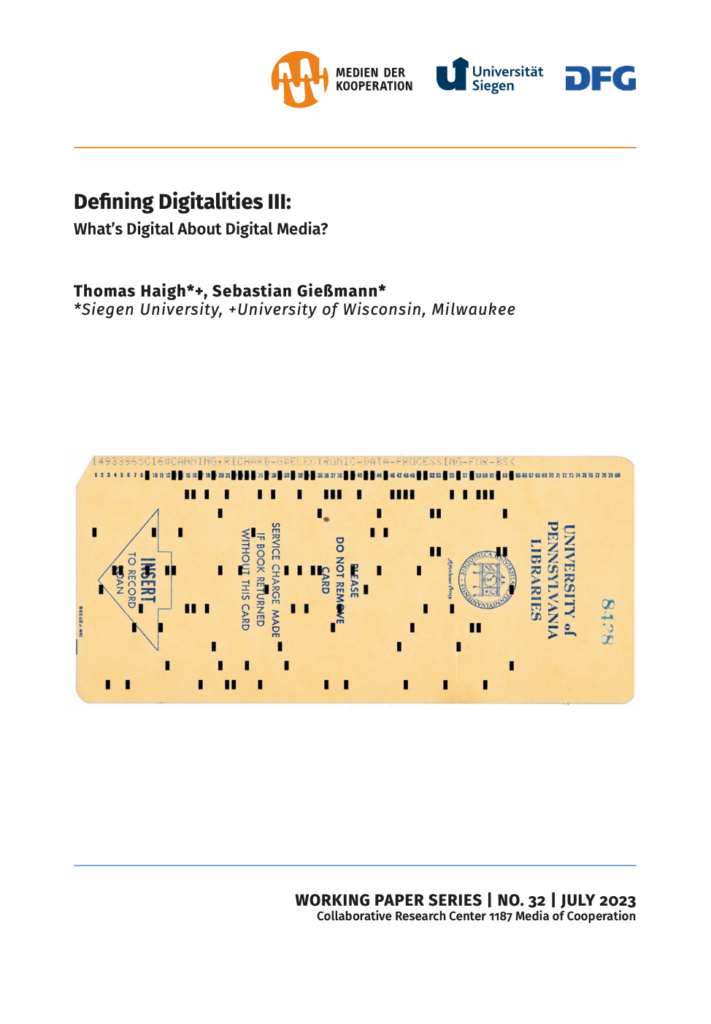
Cover Working Paper What's Digital about Digital Media?In this working paper we explore an alternative thread in the early development of media and medium as concepts: the origins of the idea of the storage medium in digital computing practices and communities of the 1940s and 1950s. While such practices were obscure at the time, they laid the technological foundation for today’s range of digital media. We discuss digitality as a feature of the practices used to read and write symbols from a medium, not a physical property of the medium itself.

We then move on to a discussion of the alphabet as itself digital, grounded in the work of Nelson Goodman. Engaging with the contributions of Matthew Kirschenbaum, we explore the limited interchangeability of representations between different encodings of the same symbols, connecting the purported immateriality of digitality to this actual fungibility of material representations.

This is a draft chapter of a book on “Defining Digitalities.” Comments are highly welcome!

Das neue Geld der Öffentlichkeit: Medienhistorisches Plädoyer für den digitalen Euro

Das neue Geld der Öffentlichkeit. Die Pläne der Europäischen Union für einen digitalen Euro bedeuten nicht das Ende des Bargelds, sondern die erstmalige Schaffung einer souveränen, sicheren Bezahlinfrastruktur. Ein medienhistorisches Plädoyer. Erschienen in der Frankfurter Allgemeinen Zeitung vom 20.9.2023, S. N4. Online unter faz.net.

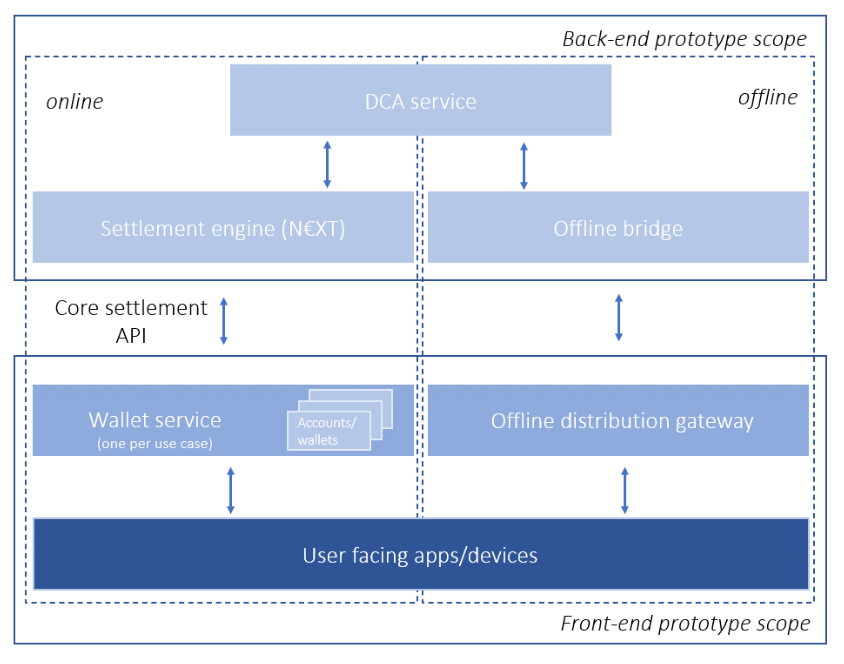
Architecture of the Digital Euro, May 2023
Architekturvorschlag zum digitalen Euro, EZB, 26. Mai 2023 – „Digital euro – Prototype summary and lessons learned“

Test: Überleben, Intelligenz, Handlungsmacht und Zukünfte in der Testgesellschaft


„Keine Deskription eines Settings ist möglich oder sogar denkbar ohne die Vermittlung einer Prüfung; ohne eine Prüfung und eine Krise können wir noch nicht einmal entscheiden, ob es ein Setting gibt oder nicht – und noch weniger, wie viele Teile es beeinhaltet.“ Madeleine Akrich und Bruno Latour

Heft 29 der Zeitschrift für Medienwissenschaft fragt, wie sich Medien und Tests wechselseitig konstituieren. Besondere Aufmerksamkeit erfahren dabei Politiken des Testens. Die Beiträger*innen schlagen vor, Tests als offene Situationen zu verstehen, in denen mit teils etablierten, teils sich erst während des Testens etablierenden Maßstäben soziotechnische Bewertungen erfolgen und Entscheidungen getroffen werden. Für einen medienkulturwissenschaftlichen Begriff des Tests gilt: In den Mikroentscheidungen des verteilten und verteilenden Testens steht das Soziale selbst auf der Probe. Die versammelten Beiträge verdeutlichen: kein Test ohne Medien – kein Medium ohne Test.

Materiality of Cooperation

Cover Materiality of Cooperation
 
The volume investigates the socio-material dimension and media practices of cooperation – before, during and beyond situations. Cooperation is understood as reciprocal interplay operating with or without consensus, in co-presence or absence of the involved actors in distributed situations. Artefacts, bodies, texts and infrastructures are the media that make cooperation possible. They enable and configure reciprocal accomplishments – and are themselves created through media practices in cooperative situations.

Pre-Face

Materiality of Cooperation—An Introduction
Sebastian Gießmann, Tobias Röhl, Ronja Trischler

Before the Situation

What’s Digital About Digital Communication?

Cover Working Paper What's Digital About Digital Communication?Although the distinction between digital and analog was first made in the context of automatic computers, the concepts were quickly broadened to apply to media and communication systems of all kinds. This working paper continues work on both fronts by looking at the historical broadening of the concept of digitality to include non-numerical systems of representation such as those used to encode text and pictures. This conception underlies the ability of computers to deal with things other than numbers, but it has its roots in communications theory, most famously in the work of Claude Shannon.

In parallel with our historical description of the emergence of non-numerical conceptions of digitality we broaden our analytical treatment of digitality to encompass more historical technologies and reading practices: not only adding machines and punched cards, but also musical boxes, weaving systems, movable type, and even alphabets and hand gestures.

This is a draft chapter of a book on “Defining Digitalities.” Comments are highly welcome!