Histories of Tracking


Histories of Tracking Conference
Université de Luxembourg | Universität Siegen
September 30 – October 2, 2026
Location: Black Box, MSH, Belval Campus, Esch-sur-Alzette, Luxembourg
https://www.uni.lu/c2dh-en/events/histories-of-tracking

Surveillance has become ubiquitous in digital media environments and is now taken for granted. With every PayPal interaction, at the least more than 600 trackers eavesdrop on its transactional data (Schneier 2018). While there is no lack of critique on digital surveillance and its discontents, its ubiquity and naturalization itself require more explanation. Which historical and economical trajectories have led into the current escalation of digital tracking, tracing, monitoring, classification, intelligence service, and advertising? How can we discover and mobilize counterpoints and narratives that explain digital surveillance otherwise? Do micro-level media, data, and sensor practices represent “yet another mutation of capitalism,” to quote from Gilles Deleuze’s famous Postscript on the Societies of Control (1990)?

Tracking persons, emotions, objects, apparatuses, money, signs and data is a veritable environing technique. It is also one of the key business applications of platform and data economies, which provide for the infrastructures of state-side institutional surveillance and control. With our joint Luxembourg-Siegen conference on Histories of Tracking we aim to track the trackers historiographically, technologically, and ecologically.

In a seminal text, Phil Agre (2003 [1994]) has encouraged us to think about the difference between rather centralized regimes of (visual) surveillance and data-based institutional regimes of “capture.” Agre has paved the way for a logistical theory of digital surveillance that investigates its micropolitics. While non-visual alphanumeric modes of capturing data do not feel like surveillance, they nonetheless establish an ever more mundane and affective mode of ubiquitous surveillance. What if we follow Agre’s analysis of institutional “grammars of action” that afford a whole spectrum of capturing, monitoring, sensing, and surveillant practices? Histories of tracking, we assume, are histories of the institutions, corporations, and agencies that create the tapestry of surveillance (Lauer 2017). That tapestry might seem all-encompassing and seamless by now, even if it contains loose threads, loopholes, and islands of encryption.

Histories of tracking are co-operative histories that involve the consent, non-consent and dissent of digital media usage (Jones 2024). They are also business histories that rely on what Shoshana Zuboff (2019) has aptly called a “behavioral surplus” of data. Last but not least, histories of tracking are histories of its public scrutiny and accountability, from opposing civil rights movements to the political and legal controversies that make the case for regulation.

We thus invited dedicated contributions from Media and Cultural Studies, History, Science and Technology Studies, Surveillance Studies, Platform Studies, Code Studies, Socio-Informatics, Law, and Sociology that combine historiographic and empirical work with grounded theoretical approaches.

„Histories of Tracking“ weiterlesen
Lehrveranstaltungen im Wintersemester 2026/27


Im Wintersemester 2026/27 biete ich folgende Lehrveranstaltungen in der Siegener Medienwissenschaft an:

  • Netzwerkkulturen von Telegraphie zu KI
    (Vorlesung Medien- und Kulturtechnik)
    Unisono | Moodle
  • Peter Weirs Kino der Zivilisationskritik. Eine Retrospektive
    (Seminar Kulturwissenschaftliche Analyse/Kulturgeschichte)
    Unisono | Moodle
  • Foucault 100
    Unisono | Moodle
  • Situating Artificial Intelligence (Forschungsprojekt, Master)
    Unisono | Moodle

In der Kölner Medienkulturwissenschaft biete ich im Rahmen meiner Privatdozentur für Medienkulturwissenschaft ein MA-Seminar an:

  • Medien der künstlichen Intelligenz:
    Praktiken, Situierungen, Infrastrukturen

    Klips | Ilias

„Lehrveranstaltungen im Wintersemester 2026/27“ weiterlesen

Interview by Geert Lovink on The Credit Card Book – History and Theory of Digital Payments

crossposting from the MoneyLab blog at the Institute of Network Cultures website; Interview by Geert Lovink, July 7, 2026

The Diners’ Club Credit Identification Card, circa 1953. https://www.dinersclub.com/about-us/history, 2017.


German media theorist Sebastian Gießmann has written an accessible book on the history of the credit card. In INC circles he’s known as one the organizers of MoneyLab6, which took place in Siegen in March 2019. As the book was written in German (info here), we conducted the email interview in English so that more could find out about his research. Back in 2016 I did a similar interview with him on his impressive cultural history of networks, which eventually came out in 2024 in English with MIT Press, entitled The Connectivity of Things: Network Cultures since 1832.

With great ease, Gießmann takes the reader through the US industrialization of debt, from the 19th century credit reports that would judge clients on character, capacity and capital to the post-war Diners’ Club card and the invention of the magnetic stripe encoding. The story continues with the rollout of ATMs and the market dominance of Visa and Mastercard. A special chapter is dedicated to Eurocard and the failure of Europe to come up with viable alternatives. It’s interesting to read how the introduction of the chip on the credit card coincided with the rise of online and then smart smartphone payments. This all culminates into the current push for a cashless society with ID provision in online payments and the proposals for the digital Euro (which Sebastian Gießmann spoke about at during the INC Exit Fest session on digital sovereignty).

„Interview by Geert Lovink on The Credit Card Book – History and Theory of Digital Payments“ weiterlesen

The Digital Euro Showdown: Can MoneyLab Do Politics?

Central Bank Digital Currencies (CBDCs) might as well have been our new media of monetary cooperation. And they still can be, at the least in the case of the Digital Euro. Since 2023, I have repeatedly advocated for real digital cash, financial inclusion and new public payment infrastructure for all of Europe. While we, finally, expect a political decision by the European Parliament in July, the D€ is facing competition from WERO, a pan-European PayPal competitor. Geopolitical claims for monetary sovereignty mix with twisted hopes for digital sovereignty and independence. So what can MoneyLab do next? The Austrians of Ja, Panik might have known it early on: Dance the ECB, swing die Staatsfinanzen … sing ihnen ihre Melodien, zwing sie zum Tanzen.

This is my contribution to the Institute of Network Cutures exit fest. It is part of a joint session on Politics of Digital Sovereignty with Gianmarco Christofari, Annalisa Pelizza, Sebastian Giessmann and Klara Debeljak. Geert Lovinks hosts this on June 25, Amsterdam, 13pm at OT301.

Poster INC exit fest, Amsterdam, June 24-26, 2026

Anthropic Studies: Medienkulturen unter den Bedingungen künstlicher Intelligenz

Einführungsvorlesung an der Philosophischen Fakultät der Universität zu Köln

Die Einführungsvorlesung schlägt mittels Anthropic Studies eine situierte Auseinandersetzung mit der aktuellen, neo-konnektistischen künstlichen Intelligenz vor. Sie wählt hierfür eine symmetrische Perspektive, die sowohl medien- und kulturwissenschaftlich wie im Sinne der Science and Technology Studies vorgeht. Als theoretischer Fixpunkt kommen hierbei die Arbeiten von Susan Leigh Star und Phil Agre ins Spiel. Ist „KI“ nicht das vieldeutigste Grenzobjekt, das die Informatik je hervorgebracht hat? Wenn wir in der aktuellen Superkontroverse um KI und ihre planetarischen Folgen bestehen wollen, müssen wir die Technologie zunächst in ihren institutionellen Ökologien und Grammatiken des Handels lokalisieren. Es tritt auf die Szene: Claude, der Chatbot von Anthropic. Das Prompt des Vortrags lautet: „Erzähl uns ein wenig über Deine Verfassung, Claude.“

10. Juni 2026, 16 Uhr s.t.
Universität zu Köln
Philosophische Fakultät
Seminargebäude (106), 1. Etage, Raum S11
Universitätsstr. 37, 50931 Köln

KVB-Haltestelle: Universität
Open Street Map: https://www.openstreetmap.org/way/128504202#map=19/50.926836/6.927502
Google Maps: https://maps.app.goo.gl/qdTXs5S8APUekLGLA Logo der KI Claude

Anthropic Studies, or What Does Artificial Intelligence Even Mediate?

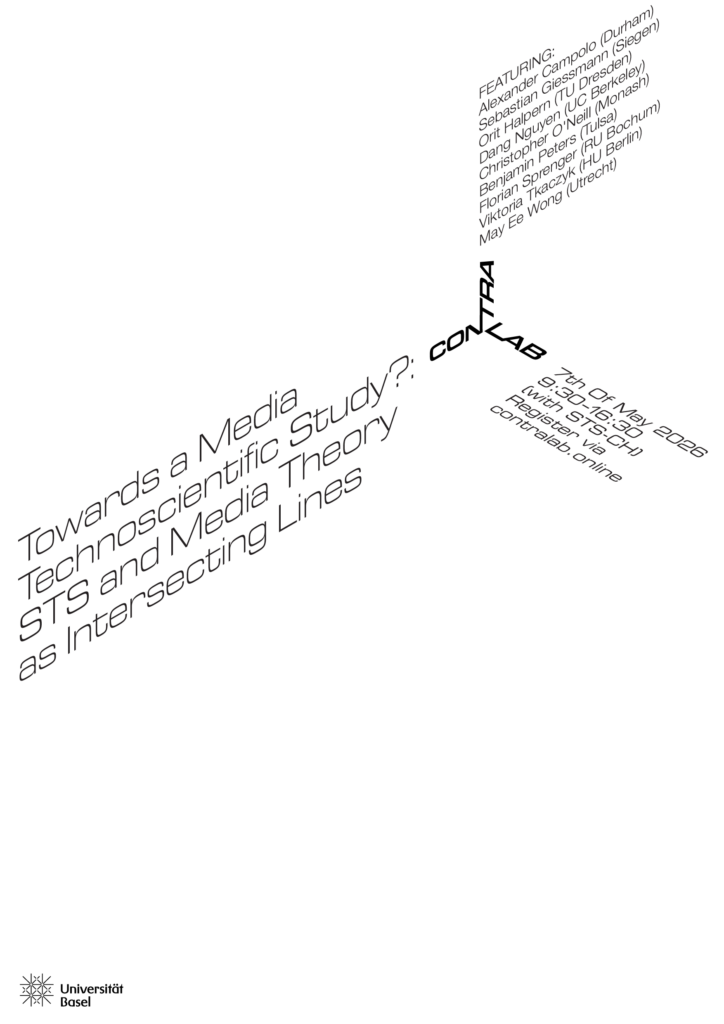
Poster conference Towards a Media Technoscientific Study?: STS and Media Theory as Intersecting Lines, Basel, May 7 2026


Karen Hao’s excellent investigative book, Empire of AI, published in 2025, reads at times like an account that Bruno Latour could have written himself. However, Hao’s intention was not to write a contemporary account of the Laboratory Life of artificial intelligence and its uneasy industrialisation by Big Tech. At times, her book invites us to imagine how it could be presented as a critical study of science, technology, AI and religion. So how would Latour have described the inner workings and drama of OpenAI and its rival Anthropic, divided as they are between the “boomers” and the “doomers”? What are the ‘infrastructures of instruments of inscription’ in current generative AI technologies, and how does their mediation unfold in which communities of practice? Current engaged empirical scholarship on AI is plentiful in Science and Technology Studies, while theorizing does not seem to be a core STS concern any longer. Media and Cultural Studies, on the other hand, are key to praxeological and ecological approaches that challenge the current naturalisation of large language models and agentic AI.

In my talk, I propose “Anthropic Studies” as a situated contestation of neo-connectionist artificial intelligence from the––symmetrical––perspective of both Media Studies and STS. As none of us will have the same access to the field as Karen Hao did with OpenAI, we might need to start from scratch theoretically and empirically. Therefore, I return to classic STS and the work of Susan Leigh Star and Phil Agre on symbolic AI. Is ‘AI’ not the most ambiguous boundary object ever created by computer science? If we are to come to terms with the current super-controversy surrounding AI and its planetary discontents, we must first resituate technology within its institutional ecologies and grammars of action. Enter: Anthropic’s Claude (not Shannon). Prompt: “Tell me a little bit about your constitution, Claude.”

This is my May 7 contribution to the Symposium Towards a Media Technoscientific Study?: STS and Media Theory as Intersecting Lines at Basel University’s contralab.

Digitale Unabhängigkeit und monetäre Souveränität jetzt! Wie wollen wir in Europa bezahlen?

Keyvisual  re:publica26  Never  Gonna  Give  You  Up

Digital unabhängig, monetär souverän und technisch auf dem allerneuesten Stand: Europa braucht neue kooperative Infrastrukturen des Geldes. Wir diskutieren mit Euch, was wir als Zivilgesellschaft anhand der aktuellen politischen Bedingungen tun und fordern müssen.

Nach dem Angriffskrieg auf die Ukraine zeigt es das offen hegemoniale Vorgehen der US-Regierung: Die aktuellen geopolitischen und ökonomischen Entwicklungen erfordern die europäische Unabhängigkeit digitaler Zahlungsinfrastrukturen. Ob Europa den digitalen Euro will, ist nicht mehr die einzige Frage. Sondern: Wie kann überhaupt das Halten und Bewegen von Geld hinreichend autonom, sicher und bürgernah ausgestaltet werden? Löst der digitale Euro – für den inzwischen erste Industrieaufträge vergeben wurden – das Problem fehlender monetärer Souveränität?

Die Philosophin Petra Gehring und der Medientheoretiker Sebastian Gießmann treten seit Jahren für eine bürgernahe Ausgestaltung digitaler Zentralbankwährungen ein. Nun lenken sie den Blick auf die Unabhängigkeitsfrage und diskutieren mit Euch, wie Forderungen an den digitalen Umbau der Finanzwelt real werden – angesichts der geopolitischen Lage Stand heute.

20. Mai 2026
STATION Berlin
Stage 6
11:45-12:15 Uhr

Hier klicken, um den Inhalt von www.youtube-nocookie.com anzuzeigen.

Infrastructures and/as Environments: Practices and Ecologies of Circulation

Circulation is what is turning infrastructures into lived ecologies.

I am still wondering how to grapple with the relation of infrastructures and environments in media theory. Praxeology and media ecology do not convergence easily––even if media practices are infrastructural and environmentally situated at the same time. Here’s a first take on the subject, a Berlin keynote lecture that has now become an elegantly edited microform podcast. My gratitude goes to the members of the DFG research training group “Literatur- und Wissensgeschichte kleiner Formen” at Humboldt-Universität zu Berlin, and especially Johann Gartlinger and Marie van Bömmel for the smooth editing and moderation.

“Infrastructures and/as Environments: Practices and Ecologies of Circulation”. Lecture by Sebastian Gießmann, in: microform. Der Podcast des Graduiertenkollegs Literatur- und Wissensgeschichte kleiner Formen, available at: www.kleine-formen.de/infrastructures-and-as-environments, Berlin 2026 [March 26, 2026].

Das Kreditkarten-Buch: Geschichte und Theorie des digitalen Bezahlens

Patentzeichnung zur Freischaltung des Smartphones per biometrischer Identi kation des Gesichts. Apple, 2019.

Bar oder mit Karte? Oder doch mit App oder Blockchain? Sebastian Gießmanns rasante Geschichte der Kreditkarte führt uns in die verborgenen Welten des digitalen Bezahlens. Sie zeigt erstmals, wie unsere digitale Gegenwart in Nordamerika mit einer kleinen Plastikkarte begonnen hat, was Magnetstreifen und Chips eigentlich bedeuten und wie Europa einmal führend im digitalen Bezahlen werden konnte. Gießmann führt die Leser:innen elegant in die verschwiegene Innenwelt von Banken, Kreditkartenorganisationen und computerisierter High-Tech-Sicherheit. Er würdigt die Alltäglichkeit der Transaktion ebenso wie die irrwitzigen true crimes des Kreditkartenbetrugs.

Das Kreditkarten-Buch fragt nach der Wahrheit hinter den Werbeslogans, Firmenlogos und Fernsehspots. Wie wir bezahlen, ist politisch. Soziale Teilhabe und Differenz, Konsum, finanzielle Überwachung, die Zukunft des Bargeldes: Im digitalen Bezahlen steht nicht weniger auf dem Spiel als unsere ökonomische Identität.

Erscheint im März 2026 beim famosen Berliner Kulturverlag Kadmos. Eine Leseprobe ist auf der Verlagshomepage einsehbar. Please support your favorite independent publishers and bookstores! Threads zum Buch gibt es auf Mastodon und Bluesky.

Inhaltsverzeichnis

1 Geschichte und Theorie des digitalen Bezahlens (1832−2014)
1.1 The Nothing Card – The Nothing App
1.2 Praktiken und Körper, Objekte und Infrastrukturen
1.3 Welche Geschichte des Bezahlens?

2 »Credit Card Nation«: Die Industrialisierung der Schulden in den USA
2.1 Anschreiben und Aufschieben
2.2 Kreditkarten ohne Plastik – und mit
2.3 Zur Etablierung von Visa und Mastercard

3 Standard und Automat, Zeitung und Fernsehen
3.1 Ein amerikanischer Standard: ANSI X4.13 und der Magnetstreifen
3.2 Am Geldautomaten
3.3 Wie man mit Kreditkarten betrügt
3.4 Werbespot und Fernsehserie

4 Europas Ringen um die Zahlungssysteme
4.1 Papier oder Plastik?
4.2 Der Fall der Eurocard
4.3 Chip um Chip: Smart Cards und EMV als globaler Standard
4.4 Mittelschichtenträume: Globalisierungen der Kreditkarte

5 Digitales Bezahlen im 21. Jahrhundert
5.1 Amazon, PayPal und das World Wide Web
5.2 Das iPhone, Apple Pay und »Network Tokenization«
5.3 Karten-Botschaften und die Zukunft des Bargelds