Interview by Geert Lovink on The Credit Card Book – History and Theory of Digital Payments

crossposting from the MoneyLab blog at the Institute of Network Cultures website; Interview by Geert Lovink, July 7, 2026

The Diners’ Club Credit Identification Card, circa 1953. https://www.dinersclub.com/about-us/history, 2017.


German media theorist Sebastian Gießmann has written an accessible book on the history of the credit card. In INC circles he’s known as one the organizers of MoneyLab6, which took place in Siegen in March 2019. As the book was written in German (info here), we conducted the email interview in English so that more could find out about his research. Back in 2016 I did a similar interview with him on his impressive cultural history of networks, which eventually came out in 2024 in English with MIT Press, entitled The Connectivity of Things: Network Cultures since 1832.

With great ease, Gießmann takes the reader through the US industrialization of debt, from the 19th century credit reports that would judge clients on character, capacity and capital to the post-war Diners’ Club card and the invention of the magnetic stripe encoding. The story continues with the rollout of ATMs and the market dominance of Visa and Mastercard. A special chapter is dedicated to Eurocard and the failure of Europe to come up with viable alternatives. It’s interesting to read how the introduction of the chip on the credit card coincided with the rise of online and then smart smartphone payments. This all culminates into the current push for a cashless society with ID provision in online payments and the proposals for the digital Euro (which Sebastian Gießmann spoke about at during the INC Exit Fest session on digital sovereignty).

„Interview by Geert Lovink on The Credit Card Book – History and Theory of Digital Payments“ weiterlesen

Das Kreditkarten-Buch: Geschichte und Theorie des digitalen Bezahlens

Patentzeichnung zur Freischaltung des Smartphones per biometrischer Identi kation des Gesichts. Apple, 2019.

Bar oder mit Karte? Oder doch mit App oder Blockchain? Sebastian Gießmanns rasante Geschichte der Kreditkarte führt uns in die verborgenen Welten des digitalen Bezahlens. Sie zeigt erstmals, wie unsere digitale Gegenwart in Nordamerika mit einer kleinen Plastikkarte begonnen hat, was Magnetstreifen und Chips eigentlich bedeuten und wie Europa einmal führend im digitalen Bezahlen werden konnte. Gießmann führt die Leser:innen elegant in die verschwiegene Innenwelt von Banken, Kreditkartenorganisationen und computerisierter High-Tech-Sicherheit. Er würdigt die Alltäglichkeit der Transaktion ebenso wie die irrwitzigen true crimes des Kreditkartenbetrugs.

Das Kreditkarten-Buch fragt nach der Wahrheit hinter den Werbeslogans, Firmenlogos und Fernsehspots. Wie wir bezahlen, ist politisch. Soziale Teilhabe und Differenz, Konsum, finanzielle Überwachung, die Zukunft des Bargeldes: Im digitalen Bezahlen steht nicht weniger auf dem Spiel als unsere ökonomische Identität.

Erscheint im März 2026 beim famosen Berliner Kulturverlag Kadmos. Eine Leseprobe ist auf der Verlagshomepage einsehbar. Please support your favorite independent publishers and bookstores! Threads zum Buch gibt es auf Mastodon und Bluesky.

Inhaltsverzeichnis

1 Geschichte und Theorie des digitalen Bezahlens (1832−2014)
1.1 The Nothing Card – The Nothing App
1.2 Praktiken und Körper, Objekte und Infrastrukturen
1.3 Welche Geschichte des Bezahlens?

2 »Credit Card Nation«: Die Industrialisierung der Schulden in den USA
2.1 Anschreiben und Aufschieben
2.2 Kreditkarten ohne Plastik – und mit
2.3 Zur Etablierung von Visa und Mastercard

3 Standard und Automat, Zeitung und Fernsehen
3.1 Ein amerikanischer Standard: ANSI X4.13 und der Magnetstreifen
3.2 Am Geldautomaten
3.3 Wie man mit Kreditkarten betrügt
3.4 Werbespot und Fernsehserie

4 Europas Ringen um die Zahlungssysteme
4.1 Papier oder Plastik?
4.2 Der Fall der Eurocard
4.3 Chip um Chip: Smart Cards und EMV als globaler Standard
4.4 Mittelschichtenträume: Globalisierungen der Kreditkarte

5 Digitales Bezahlen im 21. Jahrhundert
5.1 Amazon, PayPal und das World Wide Web
5.2 Das iPhone, Apple Pay und »Network Tokenization«
5.3 Karten-Botschaften und die Zukunft des Bargelds

Money, Credit, and Digital Payment 1971/2014: From the Credit Card to Apple Pay

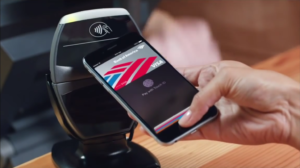
NFC terminal with iPhone 6, video still, 2014The article intertwines the history of the American credit card, its standardization, and interactional realization with the latest developments in payment systems. Understanding both credit cards and systems like Apple Pay or blockchain-based applications as part of an administrative longue durée, it argues for a different understanding of the Internet of Things. It should be understood both as a technical-informational and as an accounting infrastructure, with tensions arising between both segments.

Check out the full text, published in Administration and Society’s special issue on ICT@Administration at https://doi.org/10.1177/0095399718794169.

„A philosophy of weaving the web“ – NECSUS Interview with Geert Lovink [reblog]

by Geert Lovink
[originally published in the Spring 2016 edition of NECSUS, „Small Data“
Creative Commons license: CC BY-NC-ND 4.0]

Unlike predictions, ‘networks’ are on their way out. The reason for this is the unprecedented concentration of money, power, and infrastructures in the hands of a few monopoly players. Instead of ‘social networks’ we speak of ‘social media’, and that is no coincidence. In fact, ‘network theory’ has followed this trend for some time and has been in relative decline for longer than we might be aware. We can consider the 1990s the golden period of network theory, dominated by a scientific-mathematical method (Barabasi, Watts) and also a social science approach (Castells). Since the crisis of the rhizomatic and productivist Deleuze and the subsequent rise of ‘dark Deleuze’ (Culp), the question has become: why connect, if machines will connect us regardless?

„„A philosophy of weaving the web“ – NECSUS Interview with Geert Lovink [reblog]“ weiterlesen

Fluctuating Networks, Un/stable Platforms, and the Internet of Things

So here is what I wrote as an abstract for a talk on April 14, 2015. It was hosted by the fabulous Digital Cultures Research Lab and took place at the Stadtarchiv of Lüneburg.

My talk is go­ing to pre­sent some preli­mi­na­ry thoughts on the no­ti­on of “boun­da­ry ob­jects” in di­gi­tal in­fra­struc­tu­res. I am going to reconsider the relation “networks” and “platforms” from a network historical and STS point of view. The “Internet of Things” is actually fairly old, if confronted with earlier special purpose digital networks. But how may we speculate already on its remediating qualities in terms of new objecthood, networked agencies, and platform regulations?

I always wanted to refurbish the slides which I had written with the LaTeX beamer class for a change. But now we have got  the audiovisual documentary – splendid. Huge thanks to all the great people at DCRL! (And I still have to rework the slides at some point).

Hier klicken, um den Inhalt von Vimeo anzuzeigen.
Erfahre mehr in der Datenschutzerklärung von Vimeo.

DCRLecture: Sebastian Gießmann – Fluctuating Networks, Un/stable Platforms, And the Internet of Things

from Centre for Digital Cultures on Vimeo.

Credit Card Mobilities

The Swiss Federal Archives have been publishing a video documentation of their „ICT@Admin“ conference. I had the privilege of being a part of this, so I include the video and abstract of my talk here. A complete documentation is also online, and the overall YouTube playlist is highly recommended.

CREDIT CARD MOBILITIES (Sebastian Gießmann, Siegen, March 26 2015)

The talk sketches out a praxeological history of the credit card, with an emphasis on its mediating qualities and operational status within bureaucratical frameworks. Temporal borrowing via credit card is regarded as a highly dynamic social technology that produces emergent topologies through distributed mobile payments. The formative years of the American credit card (1950-1975) are analyzed along with approaches from ethnomethodology (Harold Garfinkel) and actor network theory (Michel Callon). Cooperative media practices are key to understanding the relation between the administrative handling of „accounts“ and emerging social networks. This includes (1) Dining, traveling, and charging, (2) Accounting for trust and credit, (3) Mass mailing and advertising new ways of payment, (4) Building „co-opetitive“ platforms for networks and (5), the digital momentum of credit cards as immutable mobiles.


Hier klicken, um den Inhalt von YouTube anzuzeigen.
Erfahre mehr in der Datenschutzerklärung von YouTube.